
Thursday, October 1, 2026


Non-birders must wonder what motivates serious birders to be so dedicated to our hobby — week after week, year after year, looking again and again at the same birds and often in the same location — our own yards.
The answer, of course, is because “you never know.” Birds are very predictable — until they’re not. And if you look long enough, there might be a moment of utter surprise.
Earlier this month this played out in real time at the home of Bill Shelmerdine. Bill, retired from the U.S. Forest Service, is a respected lifelong birder who volunteers as the compiler of the annual Olympia Christmas Bird Count.
Bill’s home is adjacent to Eld Inlet near west Olympia, and among other many birding activities, he has hummingbird feeders there. On March 11, he noticed a peculiar hummer visiting the feeder outside his kitchen window. This bird looked unusual, somewhat like an adult rufous hummingbird female, but with more color than expected on its gorget (gorget is what we call the bright iridescent color patch that hummingbirds, particularly males, have on their throats).
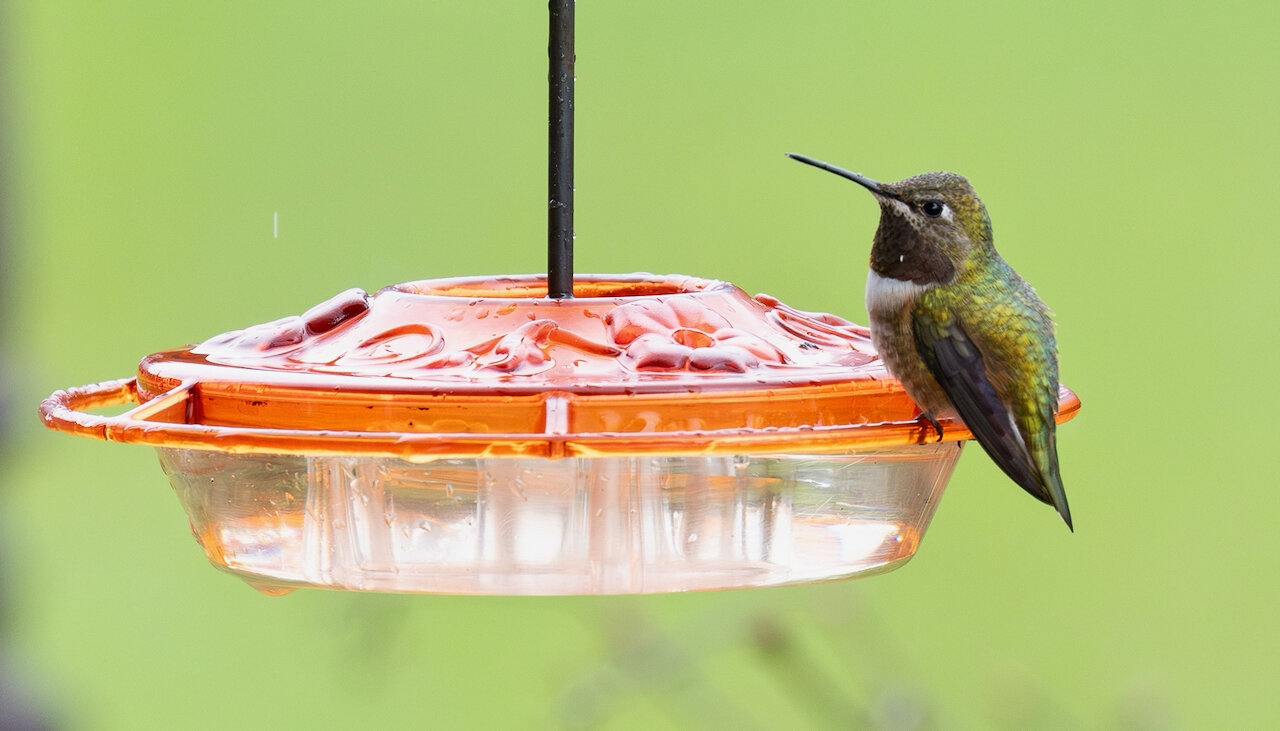
The bird came and went, as feeder visitors do. Bill made more observations and took photographs, and, after consulting with others, concluded that the bird was an Anna’s x Rufous hybrid, and likely an adult male. Hybrid birds are unusual and Bill posted a note about his visitor on the ebird Washington Rare Bird Alert.
When Liam Hutcheson, learned about this unusual avian visitor, he arranged to visit Bill’s home on March 12. The bird was visiting its favorite feeder at intervals of about 30 minutes and Liam was able to take great photographs. Three of the best are accompanying this account and they attest to what regular Thurston’s Birds readers already know — Liam is a remarkably talented photographer!

The rare visitor was again coming to the feeder in the morning of March 13 but, as you might recall, in midmorning that day we were visited by an unseasonal snowstorm. The visiting hybrid, and several other “normal” hummingbird guests at Bill’s hummingbird diner, disappeared that day and no hummingbirds visited for the next two days. When better weather developed, hummingbirds again visited Bill’s feeders but the hybrid was not among them.
What happened? Unfortunately, it’s likely that the cold weather killed the hummers. However, it’s also possible that they entered into a torpor, a state of extreme inactivity, and survived the cold, but then relocated to another part of the county.
Up to this point it’s an interesting story, but it gets better. Bill submitted Liam’s photographic record (we are publishing only a sample) to a national expert on hummingbird identification. Generally, positive identification of a rare hummingbird depends on careful identification of feather details (for example the presence and degree of white on the tail feathers).

Liam’s photographs permitted identification of this bird as a female Anna’s x Rufous hybrid, the only such hybrid even documented. Talk about a rare bird — the only one! As one knowledgeable person told me, this is easily the rarest bird ever seen in Thurston County.
Bill Shelmerdine, at least on March 11, looked over his hummingbird visitors carefully and the result was documenting an extreme rarity. After hearing Bill’s story, I have found myself looking more carefully at the routine birds at feeders and in my yard. You never know!
March is the month to see migrating sandhill cranes in Eastern Washington. It’s unforgettable to see of a flock of hundreds of these large prehistoric-looking birds drifting in to land in a fallow field. The best place to see them is the Columbia National Wildlife Refuge, located just northwest of Othello. The refuge website includes a useful map of the back roads in the area.
George Walter is environmental program manager at the Nisqually Indian Tribe’s natural resources department; he also has a 45+ year interest in bird watching. He may be reached at george@theJOLTnews.com
Bird photos for this column are provided by Liam Hutcheson, an 18-year-old Olympia area birder and avid photographer.


Comments
No comments on this item Please log in to comment by clicking here