
Wednesday, October 21, 2026

| A strict state law passed three decades ago was designed to contain high density growth in Washington state, altering the fabric of our communities. In yesterday’s segment, the genesis of the Washington State Growth Management Act (GMA) was introduced. In today’s article, the GMA’s requirement for “Concurrency” will be introduced as a means of highlighting why your local government is choosing to fund specific roadway construction projects, and not others. |
The Washington State Growth Management Act (GMA) was pivotal legislation to address urban sprawl that came into effect in 1990. A key part of the law is the requirement that "Urban Growth Areas" (UGAs) be demarcated within the state:
The Urban Growth Area is the city/town and adjacent unincorporated growth area identified by the cities/towns/county to receive urban growth in the future. Outside of the boundary only rural growth is permissible.
Every square foot of privately-owned land in Thurston County is split into one of two categories mandated by the GMA: urban or rural. And the rules that apply to these two categories are significantly different. Property within the boundaries of an Urban Growth Area is zoned for more intensive use. Conversely, property on the other side of the planner’s line is zoned for larger lots and restrictive development.
In an example of how the process works in practice, consider Country Green Turf Farms at Kelly’s Corner on the south side of the Yelm Highway, a mile east of the Amtrak station. Spanning over 600 acres, customers appear to love the business: Google users have given it a 4.7 rating!
But Country Green’s land holdings are just outside the Lacey Urban Grown Area boundary, severely restricting how the property can be used. Had Country Green been located on the other side of the Yelm Highway, their property would be worth millions more.
While the arbitrariness of the placement of a planner’s boundary line can have jarring effects in specific examples like the one above, the result is as the legislation was intended.
In the context of commercial and residential uses that had been devouring the state’s rural territory, the whole point of the Growth Management Act was to say, to borrow from Job 38:11: “This far you may come and no farther.” And the line has to be drawn somewhere. Without question much of Thurston County has retained its rural character because the Growth Management Act achieved what was intended.
Within Thurston County, there are eight separately managed Urban Growth Areas. Most UGAs encompass incorporated cities, but are typically drawn to include some neighborhoods immediately adjacent to the cities themselves.
This process is governed by the regulations imposed by the GMA, as well as negotiations between the city that oversees the UGA and the county itself. A good example of this process can be found for the City of Lacey. The Seasons neighborhood, just east of Long and Pattison Lakes, is outside of the formal City of Lacey boundaries, but is inside Lacey’s Urban Growth Area. Consequently, the area allows for denser development compared to the neighborhoods immediately to the east or south.
There are seven incorporated cities in Thurston County: Bucoda, Lacey, Olympia, Rainier, Tumwater, Tenino and Yelm, and each of them oversee a local Urban Growth Area. There’s even a UGA that encompasses unincorporated Ground Mound. With only 3,301 residents (and three gas stations!) Grand Mound's residents might be surprised to learn of their urban designation. Thurston County’s eight UGAs are shown below (click image to enlarge):
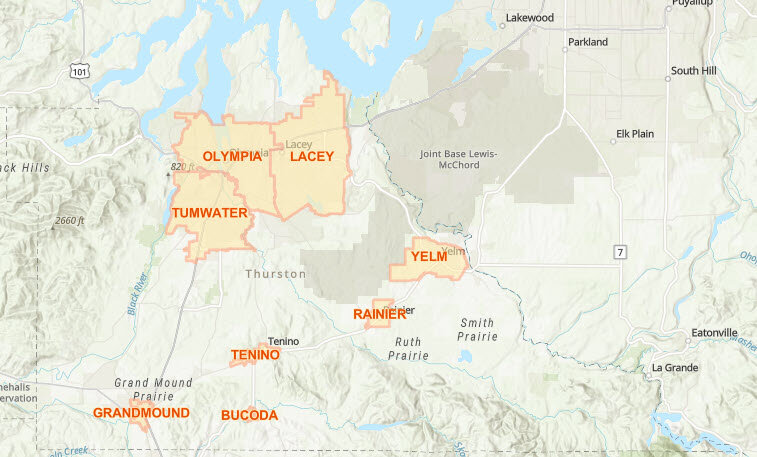 Thurston County's Urban Growth Areas
Courtesy Thurston County GeoData Center
Thurston County's Urban Growth Areas
Courtesy Thurston County GeoData Center
As you drive around the peripheries of our cities, pay attention to how recently built higher density housing subdivisions seem to abruptly stop being built. This is no accident.
In Tumwater, new homes can be spaced seven per acre. These areas are zoned “Single-Family Low Density Residential.” Yet, that is 35 times more dense than what is allowed outside the county’s UGAs, where single-family housing typically needs to be built on parcels of at least 5 acres.
The UGA boundaries explain why you won’t see a future housing development of closely built homes permitted north of Squaxin Park in Olympia, west of Black Lake in Tumwater, or north of the Centralia Canal in Yelm. Again, this is exactly the outcome that was intended by the Growth Management Act.
As described by the Washington State Department of Commerce, the Growth Management Act’s regulatory framework is based on “14 goals local governments must consider in land use planning.” One of those goals is the awkwardly named “Concurrency” requirement.
Concurrency includes the mandate that a city can’t permit new development without also planning for the concurrent provision of transportation infrastructure sufficient to meet that new development’s increased roadway capacity needs.
As an example, the City of Olympia cannot issue a permit for a new large retail development within its UGA without also having near-term plans to ensure that sufficient capacity exists to satisfy the increased volume of traffic that would result.
As a regulatory philosophy, concurrency has several attractions: don’t allow development that is going to create unreasonable congestion. But, as in so many things in life, the devil is in the details.
For instance, how does a municipality know how much traffic a given development will create? Who decides how much incremental roadway capacity is enough? And who pays to make these determinations, and then build any improvements that might be required?
A process can be developed to answer each of these questions, of course. For instance, there are urban planning software tools and expert consultants, who can quantify how much traffic would be generated from the creation of a new big-box retailer. But the process inevitably adds costs, and reasonable persons can disagree on the correct answer to any of these questions. And disagreements invite litigation.
The concurrency requirement of the GMA has spawned dizzyingly complex planning requirements for the cities in the county, and the county itself. Every 10 years, the Comprehensive Plan for each of the eight Urban Growth Areas in the county needs to be updated to address the planning needs spawned by the Growth Management Act. And those Comprehensive Plans may themselves reference sub-plans for specific regulatory areas subject to GMA oversight, such as housing, sensitive habitat preservation, or planning coordination with the military or tribal entities.
As an example, the 2016-36 Transportation Master Plan for the City of Tumwater — itself just a subset of the city’s overall Comprehensive Plan — tops out at 150 pages. All this for a city of roughly 25,000 residents. If you have ever wondered whether your local government is being thoughtful in its planning process, the answer is an emphatic yes.
Under the urban planning regimes that have evolved as a result from the Growth Management Act, the impact of new development on traffic is assessed. And if roadway capacity needs to be increased as a result, part of the cost can be shifted to the developer.
From a public policy perspective, this is again a good thing: the developer who will reap the benefits of the new construction has to pay for that development’s impact to the community — and not the taxpayer. But it also creates fertile ground for legal disputes between the municipality determining what will be required and the developer who would prefer not to absorb those costs.
Tumwater’s Transportation Master Plan presents a symphony of detail. The overall Urban Growth Area’s boundary is broken down into sub-areas, such as The Brewery District and the Capitol Boulevard Corridor. Infrastructure needs for cars, pedestrians and bicyclists are examined. And importantly, the efficiency of every major intersection within the UGA — 69 of them to be exact — is measured, cataloged and projected over a 20-year horizon. It is these assessments that largely determine what intersections will be upgraded.
When a city’s Comprehensive Plan is updated, each major intersection is measured using a “Level of Service” (LOS) criterion, which grades how efficiently users can traverse the crossing using a continuous scale from A-F.
 Level of Service (LOS) table
Courtesy Thurston Regional Planning Council
Level of Service (LOS) table
Courtesy Thurston Regional Planning Council
An intersection assigned an LOS rating of A is operating with virtually no delays. By the time an E rating is granted, however, the situation is grim: “High level of driver frustration; high levels of delay,” according to the Thurston Regional Planning Council. Tumwater’s 2008-25 Comprehensive Plan assigned the intersection of Capitol Boulevard and Trosper Road a rating of E; pretty bad.
But as children are known to tell their parents, “Well it wasn’t an F!” As a result, the city punted and chose to do nothing: “Accept LOS E for Capitol Boulevard and intersection with Trosper ... This is consistent with Regional Planning policies for other major corridors.” But the clock ran out in 2015; the intersection was given an LOS of F.
The practical differences between a Level of Service rating of A-D are subtle: the GMA doesn’t mandate remediation, even when the intersection is imposing significant delays. But an LOS rating of E, or worse F, changes everything.
When an intersection is deemed to be failing, eventually new development in the immediate area won’t be allowed. And the reason why this would occur is the GMA concurrency requirement: transportation infrastructure capacity must keep pace with development. If it doesn’t, permits cannot be issued for new developments.
If new development will cause the transportation system to exceed the established LOS standards, the jurisdiction must deny the development unless transportation improvements and strategies are implemented to accommodate the development within six years, a process known as concurrency mitigation.
Ominously the intersection of Capitol Boulevard and Trosper Road, identified by the City of Tumwater decades ago as its “Primary transportation junction,” is within Tumwater’s “Capitol Boulevard Corridor,” the largest and most important redevelopment effort ever contemplated by the city.
Technically, the state of Washington did not force Tumwater to rebuild its most important intersection when it was assessed to have reached the worst Level of Service rating category. The city could have chosen to keep the intersection as it was — indefinitely — at the cost of freezing new development in the area.
But choices like this are no choice at all. Municipalities live and breathe on the jobs and increased taxes generated by development. Even though it would eventually cost $20 million to execute the Capitol Boulevard and Trosper Road Intersection Reconfiguration project, there was never any serious question as to whether the city would do so. The requirements of the Growth Management Act forced Tumwater’s hand.
The promulgation of the Washington State Growth Management Act has inalterably changed the nature of new development across Thurston County. Urban growth has been contained within explicitly demarcated areas, forcibly limiting urban sprawl. This is almost certainly a net positive to the region’s residents.
But implementing the GMA’s requirements requires constraining what both developers, as well as average residents, may undertake. And none of this has been achieved without imposing substantial costs on both businesses and residents alike.
In tomorrow’s segment: Clark Griswold’s nightmare: How roundabouts became traffic engineers’ preferred solution.
Read the previous installment in this series on The JOLT News website:
Part 1: The Creation of Washington’s Growth Management Act


11 comments on this item Please log in to comment by clicking here
RondaLarsonKramer
Thank you once again for doing a deep dive on such an important topic. The concurrency rule is vital for keeping local governments from overextending themselves and biting off more than they can chew. An elected official with no urban planning experience can sometimes be susceptible to wining and dining by developers who own cheap land on the fringe of urban areas. It's very easy, as a result, for local governments to sometimes succumb to promises of such developers about all the tax money that will flow to city coffers as a result of a new development. But development rarely pays for itself. By approving new development on the fringes of urban areas, it forces the local governments to essentially subsidize new development that leapfrogs beyond the current extent of municipal infrastructure. For example, Lacey did not abide by the concurrency rule for a long time. It over-extended itself for decades and is now paying the price in terms of its struggling budget.
One correction I would make to the article involves this statement, "While the arbitrariness of the placement of a planner’s boundary line can have jarring effects in specific examples like the one above, the result is as the legislation was intended." The boundary may seem arbitrary. But it was never arbitrary. Gordon White was a planner for the county who was instrumental in drawing the boundaries of urban growth areas in north county. As he has explained it, he and others were quite deliberate in their choices on where to place the boundaries, taking into consideration critical areas, working forests, existing pockets of dense development, water bodies, and other features of the existing landscape.
Tuesday, June 16 Report this
stepup
Well-written report. Thank you. I'm looking forward to the next chapters. If voters are to support good public policy, especially around containing the high cost of housing these days, voters must better understand how the GMA affects our quality of life in unexpected ways.
I would hope the series addresses the impact of the GMA on housing costs, particularly owner-occupied, single family residences for which costs have skyrocketed to among the highest in the nation since GMA came on Washington's scene. As this article reports, the GMA boundary produced stark economic impacts. And while the value of Green Turf Farms' acreage is much lass as a GMA-outsider, the "manufactured" economics of 7 houses per acre for -insiders together with the natural economic effect of artificially limited supply constrained by GMA boundary, means a tiny slip of land became a goldmine for grandfathered land holders inside the GMA boundaries.
Looking at a Thurston County Assessor record for one such parcel in a 15year old mid-priced development in Tumwater, the residence sits on 1/10 of an acre, apportions $130,000 alone to that postage stamp-sized lot--slightly larger than the footprint of the building itself. Extrapolating that value across 5acres suggests this land has a market value of $6.5Million. Yes! Do the math. Now, of course, developed land, with utilities, etc., is not equivalent to undeveloped land, but economics tells us $6.5Million suggests the probability of that a dramatic supply/demand distortion of market prices/value is going on here.
What economics reveals is that that artificially low supply results in artificially high prices. (It's the method of monopolies.) Also-limited number of 5acre parcels outside the boundary provides for 1 residence each; 5 acres inside the boundary provides 35 residences and whole host of expensive impact fees and costs. All while that same land is also forced to compete with multi-family residence developers.
What happened to transitional zoning providing for new 1 or 2 or 3 houses/acre? Why?! Public policy and the GMA and its boundaries.
Tuesday, June 16 Report this
RondaLarsonKramer
@stepup, I would like to clarify something regarding the Growth Management Act and housing prices. You correctly note that urban land is worth more than rural land. But that difference reflects the fact that land inside urban growth areas can accommodate many more homes, businesses, roads, utilities, schools, and services. The value is created largely by public infrastructure and development rights, not merely by the existence of a boundary.
Since the GMA's adoption, Washington's population has grown by millions of people. Without urban growth boundaries, that growth would likely have consumed substantially more farmland, forests, and resource lands while still facing many of the same housing market pressures.
The belief that the GMA artificially restricts housing supply is a common misconception. The GMA does limit urban-style development in rural areas, but it also requires cities to accommodate projected population growth inside urban growth areas. The increase in urban housing capacity outweighs the reduction in rural housing capacity.
In Thurston County, for example, the 2021 Buildable Lands Report found substantial remaining development capacity inside existing urban growth areas. Since then, the Legislature has added even more capacity by allowing additional housing types in areas previously limited to detached single-family homes. Duplexes, triplexes, fourplexes, cottage housing, ADUs, and mixed-use development are now allowed in many locations inside urban growth areas where they previously were not.
Importantly, these changes are not merely theoretical. Across Washington, property owners and developers are already taking advantage of these reforms by building multiple homes on lots that previously could accommodate only one. The result is more housing opportunities within existing urban areas without converting rural forests and farmland into sprawling subdivisions.
As for affordability, housing prices have risen sharply in many metropolitan areas that do not have Washington-style growth management systems. That suggests broader factors play a significant role—including population growth, income growth, construction costs, interest rates, and housing demand. The evidence does not support the claim that the GMA is responsible for Washington's housing affordability challenges (although that claim has been around since the GMA's inception).
It is also important to recognize the economic incentive underlying the claim that the GMA is responsible for affordability challenges. Rural land is generally much less expensive than urban land. As a result, owners of rural property often stand to realize substantial gains if development restrictions are relaxed and their land is made available for urban-scale development. In other words, they have an incentive to advocate against the GMA (whether conscious of that incentive or not). Although the affordability claim is an age-old argument against the GMA, the claim is as inaccurate now as it was in 1990 when the GMA was being drafted.
Wednesday, June 17 Report this
Southsoundguy
This is revealing how dumb this form of growth and development is. Pattern based development guidelines would produce a far superior environment over this.
Wednesday, June 17 Report this
Yeti1981
Interesting article and I appreciate the effort to explain a complicated aspect of the GMA that many residents may never encounter directly.
One point that deserves additional discussion is the statement that shifting infrastructure costs to developers means those costs are not borne by taxpayers. In reality, those costs do not disappear—they are ultimately reflected in the price of housing purchased or rented by future residents.
Transportation concurrency serves an important purpose, but it also raises important questions about affordability. At what point do increasingly complex planning requirements, mitigation obligations, and infrastructure costs begin to limit housing production or increase housing prices?
The challenge for local governments is not simply managing growth. It is balancing transportation needs, environmental goals, housing affordability, economic opportunity, and quality of life. The tradeoffs become especially important in communities facing significant housing shortages.
Wednesday, June 17 Report this
Yeti1981
@RondaLarsonKramer, I agree that infrastructure costs and long-term maintenance obligations need to be considered when evaluating growth. Those costs are real and should not be ignored.
That said, I would be cautious about broad statements that development rarely pays for itself. Numerous fiscal impact studies around the country, and several conducted here in Thurston County, have found that housing construction generates significant jobs, labor income, business activity, tax revenue, and ongoing economic benefits. The more interesting question may not be whether growth pays for itself, but which types of growth generate net public benefits, under what circumstances, and over what timeframe.
Housing, infrastructure, and public finance are all interconnected. In rapidly growing regions, there are also costs associated with not building enough housing, including rising home prices, increased rents, longer commutes, and workforce shortages. I suspect most people would agree that the goal is neither unchecked growth nor no growth, but growth that is fiscally sustainable and capable of meeting community needs.
Wednesday, June 17 Report this
Yeti1981
@RondaLarsonKramer to your response to @stepup, Where I would respectfully disagree is the suggestion that growth management policies have no meaningful relationship to affordability. Most housing economists would acknowledge that land availability, infrastructure requirements, permitting timelines, development regulations, and construction costs all influence housing supply and, ultimately, housing prices.
I also think it is important to distinguish between theoretical housing capacity and actual housing production. A Buildable Lands Report may identify significant capacity within an urban growth area, but capacity does not necessarily mean housing can be built economically, served by infrastructure, financed, permitted, and delivered at a price households can afford.
The GMA was designed to achieve important public goals, including protecting resource lands and directing growth into urban areas. I think the more interesting question after 35 years is not whether the GMA has benefits—it clearly does—but what tradeoffs have emerged and whether the balance between growth management and housing affordability is where Washington residents want it to be. Reasonable people can support the goals of the GMA while also asking whether constraints on land supply, infrastructure capacity, and development feasibility contribute in some way to today's housing affordability challenges.
Wednesday, June 17 Report this
RondaLarsonKramer
@Yeti1981, I agree with much of what you wrote in 2023 regarding the need for greater urban density, more housing choices, reduced parking mandates, and more efficient use of land within cities. (see https://www.thejoltnews.com/stories/olympia-city-council-approves-new-parking-code-amendments-scraps-original-no-minimum-parking,10831)
In fact, those are all examples of increasing housing capacity within the framework of the Growth Management Act.
That is why I am not persuaded by arguments that the GMA is a major cause of our housing affordability challenges. If the solution is more urban housing, more infill, more ADUs, more duplexes and fourplexes, fewer parking requirements, and better use of underutilized urban land, then the answer is to continue reforming urban zoning and development regulations—not to conclude that growth management itself is the problem.
You correctly note that theoretical capacity does not automatically become housing. But the same observation cuts both ways. If affordability problems persist despite substantial urban capacity, that suggests factors beyond the GMA are at work, including construction costs, labor shortages, financing costs, interest rates, and strong population growth.
The argument I often hear is that housing would become dramatically more affordable if we loosened growth-management restrictions and expanded development into rural areas. I have not seen evidence supporting that claim. What I have seen is evidence that urban infill, higher densities, reduced parking requirements, ADUs, cottage housing, and missing-middle housing can increase housing production without consuming additional farmland and forests.
That seems much closer to the approach you advocated in 2023 than to the argument that the GMA is a principal driver of the housing crisis.
Wednesday, June 17 Report this
someoldguy
When a roadway segment or intersection is already failing (v/c > 1.0, LOS E/F -irrespective of how an agency wants to define failure (e.g. two hour delay average based LOS (OLY))), the transportation models used to quantify incremental delay no longer behave linearly or reliably — so how can a city prove “nexus” and “proportionality” for a new development’s impact on an analytically failed HCM LOS? (See the latest 9-0 US supreme court decision in Sheetz which affects GMA/Concurrency/mitigation)
This is the unresolved problem from 2024. Let’s break it down cleanly.
⭐ 1. the modeling problem
Once v/c > 1.0, the standard tools — HCS, Synchro, SIDRA, and even the HCM equations — all break down.
Why?
✔ Delay becomes asymptotic
A few extra vehicles can produce infinite or undefined delay.
✔ The regression models lose validity
The R² of the HCM delay equations collapses in oversaturated conditions.
✔ The LOS scale stops being meaningful
LOS F covers everything from “slightly bad” to “catastrophically gridlocked.” Some agencies have used F and F+ etc. and that won't be successful in a court setting.
✔ Incremental delay cannot be reliably attributed
You cannot say:
“Your project caused 17.4 seconds of delay.”
Because the model is no longer mathematically valid once past it's operational ability.
This is not a political issue — it’s a mathematical limitation of the Highway Capacity Manual and other analytical methods. And if they try to simulate, that just opens up a ton of other points that will have a hard time in court since simulation involves art - and the Alonso curve of data accuracy and specification errors
⭐ 2. Under Sheetz, if you can’t quantify impact in a sound way, you can’t charge for it
The Supreme Court requires:
Nexus
Proportionality
If the model cannot quantify the incremental impact of a project at a failing location, then:
⭐ The city cannot constitutionally charge the developer for that impact.
Because the city cannot prove:
What the project caused
How much it caused
Whether the fee is proportional
This is the exact scenario Sheetz was designed to address. Broken system components like intersections and links are now the responsibility of the agency once they fail. Anyway, that's one way to read Sheetz. It'll take an appealed case to make it all the way up again to solidify this aspect. Until then, it's the same old game of chicken.
Oh, and then there's HSS routes. Auburn actually sent a letter to WSDOT telling them to stop asking for mitigation because under GMA, HSS was set aside. And then there are the politics of projects that will just simply have to happen - like Dupont and so many others. This topic has a rat's nest of weeds and rabbit holes to deal with and I don't wish this explanatory task on anyone -including the author if this series. No way I could do it.
Wednesday, June 17 Report this
Yeti1981
@RondaLarsonKramer, I agree that housing affordability is influenced by many factors beyond the GMA, including interest rates, labor costs, material costs, financing, and population growth. I also agree with many of the reforms you support: ADUs, duplexes, fourplexes, cottage housing, reduced parking requirements, permit streamlining, and more efficient use of urban land.
The reason I support those reforms is because they reduce barriers to housing production and increase housing supply. That is why I struggle with the conclusion that growth-management policies and development regulations play little role in affordability. If reducing regulatory barriers increases housing opportunities and helps affordability, then it follows that regulatory barriers can also reduce housing opportunities and increase costs.
Where I would respectfully disagree is the suggestion that there is little evidence connecting growth-management policies, development constraints, and housing affordability. For decades, housing economists, the National Association of Home Builders, state policymakers, and local governments have documented the effects that land constraints, permitting requirements, infrastructure obligations, impact fees, and regulatory delays have on housing production and cost. Both Olympia Master Builders and the Building Industry Association of Washington have a variety of resources showing this evidence on their web pages. Locally, we see these effects regularly. Housing projects are delayed by infrastructure limitations and concurrency requirements. Impact fees, utility connection charges, stormwater requirements, frontage improvements, and mitigation obligations add costs that are ultimately paid by future homeowners and renters. We also see dramatic differences in land values based on development rights. The article's Country Green example is a good illustration. Similar land immediately inside a UGA boundary can be worth many times more than land immediately outside it because development rights have economic value.
I also don't believe the discussion should be framed as a choice between urban infill and other housing strategies. I support infill, missing-middle housing, and redevelopment. But I also think strategic UGA expansions, UGA swaps, clustered development, and other approaches should remain available tools where they make sense. Housing affordability challenges are significant enough that we should be willing to consider a broad range of solutions. The question, in my view, is not whether the GMA has value. It clearly does. The question is whether we are willing to acknowledge that a system designed to constrain development in certain ways may also have consequences for housing affordability, land values, and housing choice. After 35 years, that seems like a reasonable conversation to have.
Thursday, June 18 Report this
RondaLarsonKramer
@Yeti1981, The arguments about environmental regulations, the GMA, and land supply constraints are all variations of the same underlying claim: that regulation is limiting housing supply and therefore causing the affordability crisis.
The problem is that the data do not support that premise in Thurston County. The 2021 Buildable Lands Report found that development capacity within existing urban growth areas exceeded projected housing needs. Since then, the Legislature has increased development capacity even further through middle-housing legislation.
Nor does the available rental market data suggest scarcity. Thurston County's apartment vacancy rate is about 5%, which is generally considered a balanced rental market rather than one experiencing scarcity. Yet affordability challenges persist, suggesting that housing affordability is influenced by factors beyond housing supply alone. Those factors include wages, transportation costs, infrastructure costs, financing costs, and insurance costs. In addition, there is a shortage of government-supported affordable housing programs to assist households that cannot afford market-rate housing.
The available evidence does not support the claim that the GMA or environmental regulations are major drivers of today's affordability challenges.
Moreover, removing growth-management and environmental regulations would shift many costs to taxpayers and households through increased infrastructure demands, longer commutes, and more dispersed development patterns. Meanwhile, it would accelerate the loss of farmland, forests, and habitat.
Tuesday, June 23 Report this