
Thursday, October 1, 2026


.jpeg)


.jpeg)

Thurston County’s Glacial Heritage Preserve is an 80-acre property purchased in 2005 and set aside for permanent protection of a now-rare land form in the county — Oak Woodlands and Prairie. It also includes forested riparian habitat along the Black River, a tributary to the Chehalis River. It’s official name, incidentally, is the Black River-Mima Prairie Glacial Heritage Preserve.
To implement its permanent protection mandate, the public can only visit this preserve only on rare occasions. The primary opportunity is an annual Prairie Appreciation Day, which this year occurred this past Saturday, May 9. Unable to resist this opportunity, Jill Severn and I were there at 7:30 a.m., joining a two- to three-hour morning bird walk prior to the general festivities.
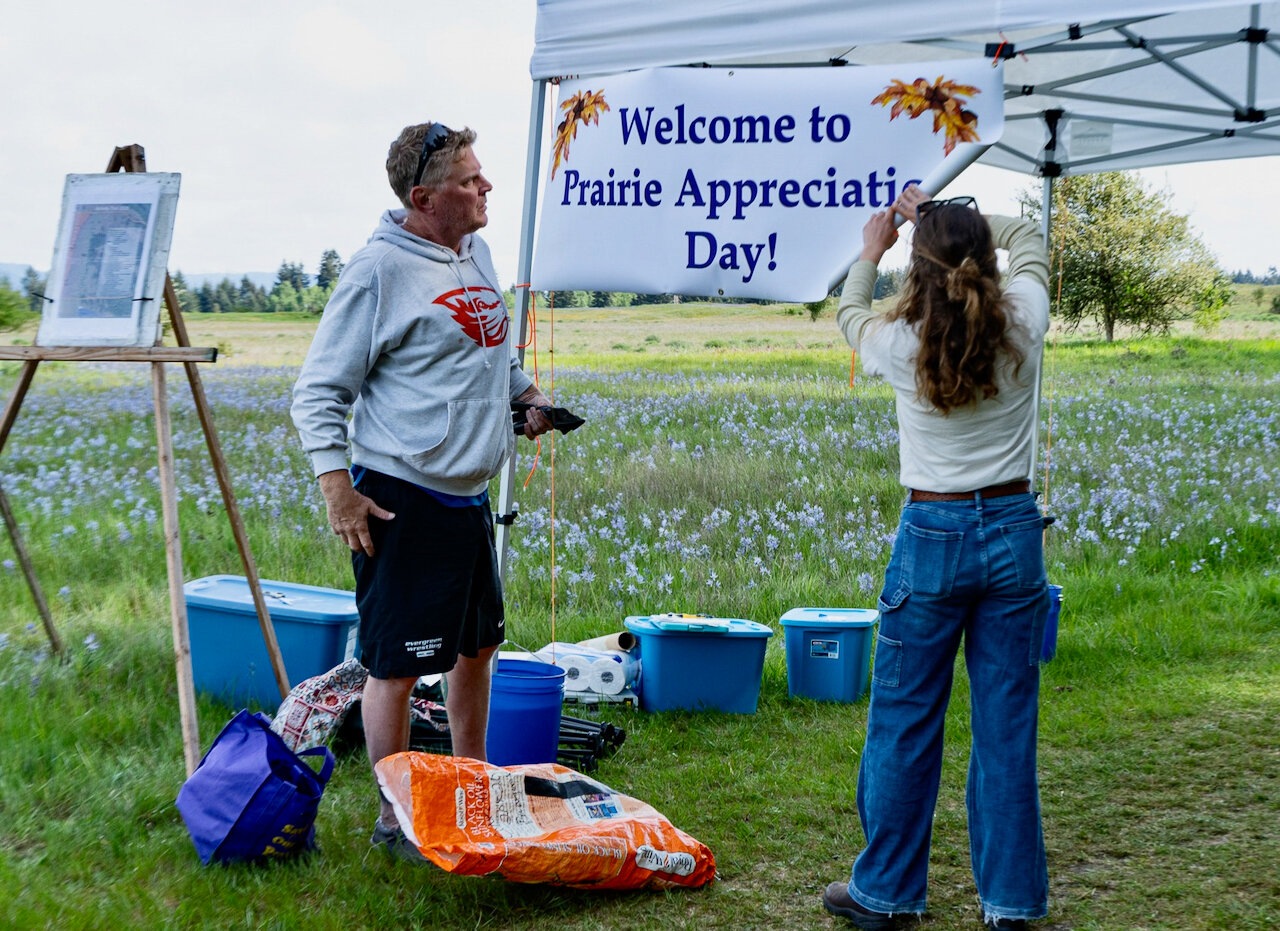
Both the birds and the prairie wildflowers were wonderful, but what really amazed me occurred as we were walking back to our car. Hundreds of other cars had arrived, and more were streaming in. This was not what I was expecting — so many people of all ages participating in this once-a-year opportunity. We were glad to see that local prairies have so many fans.
The event is hosted by Friends of Puget Prairies and its many partnering organizations. Friends President Gail Trotter said, “This is our 32nd year, and this was the most attended — we had over 1,400 people. Our goal is to make folks in our region more aware of the prairies, how they came about, and what individuals can do to understand and care for these native flora and fauna.” Judging by Saturday’s crowd, I’d say they’re meeting that goal spectacularly.
Most of the partnering organizations had interesting information booths along the walking paths, and many included children’s activities.

The booth of the Center for Natural Lands Management (CNLM) provided information about management activities. CNLM, a nonprofit organization, is dedicated to the protection and restoration of imperiled species and their habitats. And on last Saturday, its employees and volunteers were dedicated to telling the rest of us about our Pacific Northwest oak woodlands and prairies.

But what about the birds? For being relatively small (only 80 acres), the Glacial Heritage Preserve has many habitat types. There’s prairie savannah and oaks, of course, but also a small coniferous forest and a dense, tangled riparian woodland along the Black River. That’s why the preserve has more bird species than one might expect. Thirty birders, reporting their checklists on eBird, documented 54 bird species on this one day.
Some of these birds were fly-bys — turkey vultures and Canada geese for example — and some were the robins and towhees we might find in our backyards. But others were special to the preserve itself and its habitat management activities.
Over the years managers have installed poles here and there on the preserve, each with five to 10 purple martin houses. And the birds have responded. Each pole had multiple martins chatting away, discussing with each other which house would be taken by which pair. As of May 9, it seemed that this question had not been completely resolved.

But for me, the “bird of the day” was the western meadowlark. From the moment we arrived we were hearing their loud, musical song. This is their prime breeding habitat and, all day long, they were loudly asserting their territorial claims.
I suspect other visitors appreciated the ospreys. There are two nesting platforms on the preserve and two osprey pairs were busy enhancing their large stick nests prior to egg laying. The nearby Black River provides good hunting grounds for these fishing raptors and the lack of routine public access protects their nesting privacy.

Another raptor, a kestrel, was seen above the grasslands looking for prey (and entertaining the visitors, too). These are the smallest falcons, hunting rodents and even insects. And they can hover like hummingbirds. They nest in cavities and the preserve has several large nesting boxes for them to choose from. They seem to time their nesting cycle so that they have an abundance of grasshoppers to feed their demanding young. The more I read about birds the more I am impressed by the many ways they adapt, including falcons raising their young on grasshoppers!
But my takeaway thoughts from Prairie Appreciation Day are not about birds. First, I appreciate the Thurston County elected officials who set aside public funds to acquire this preserve. I appreciate the volunteers and professional employees who dedicate their time, energy, and careers to caring for “all creatures great and small” on public habitat lands.
And, finally, I appreciate how fortunate we are to live at a time when we are prosperous enough that we do not have to exploit every square inch of the Earth; and to live in a place where the abundance of nature, both avian and otherwise, is here to enjoy.
George Walter is environmental program manager at the Nisqually Indian Tribe’s natural resources department; he also has a 45+ year interest in bird watching. He may be reached at george@theJOLTnews.com
Bird photos for this column are provided by Liam Hutcheson, an 18-year-old Olympia area birder and avid photographer.


6 comments on this item Please log in to comment by clicking here
SecondOtter
Um, No. Glacial Heritage is a little under 1200 acres, not 80.
Friday, May 15 Report this
Georgewalter
Second Otter - Thanks. I appreciate you paying close attention. It sure seemed larger than 80 acres when I was walking around, but that is the acreage stated on the Thurston County website. Perhaps someone can enlighten us. Could the 1200 acre number include land not purchased by the county but still included under "glacial heritage?"
Friday, May 15 Report this
SecondOtter
No, George. First off, the land that is now Glacial Heritage wasn't purchased with public funds. The rancher who owned it who ran cattle on it. He DONATED the entire property to Thurston County "Parks and Recreation" (now called Public Works). He donated it with the stipulation that it be restored to a prairie environment. It is not a 'park', it is a preserve. No money changed hands, in fact, all the work done to restore it to what it is today was and is done by volunteers. Stewardship was first The Nature Conservancy, and when they dumped it, Center for Natural Land Management picked up the slack and continues to do so.
Thurston County itself does very little if anything to restore it. I wonder where the website author got the 80 acres. It may be they are confusing an 'inholding' the State Dept. of Fish and Wildlife have of more acreage than that. One number I have heard is 400 acres, but I really don't know.
The preserve has always been in the vicinity of 1200 acres, there has been no land 'purchased' or added to it since the donation. The part of the prairie you visited on Prairie Appreciation Day is just part of the entire preserve. There is a large forested region to the south, consisting of firs and oaks.
Saturday, May 16 Report this
Georgewalter
Second Otter - thank you so much for the detailed additional information and clarifications. All this really makes you the column's "after-the-fact" co-author.
Your account illustrates well how various parties, patiently working together to implement a vision, can accomplish great things.
I'm still struggling with "This preserve was purchased in 2005," to quote from the Thurston County website.
Tuesday, May 19 Report this
SecondOtter
Well, considering that Thurston COunty's contribution to Glacial Heritage has been strictly hands off since the mid 1990's (when real restoration began), I suppose I can believe that they think it was 'purchased' in 2005. The country contributed A porta potty for Prairie Appreciation day (yes,, ONE) and sometimes lends traffic cones to manage traffic and parking (and didn't, this year).
Which isn't a bad thing..office managers don't have a clue about environmental restoration.
Wednesday, May 20 Report this
Olywelcomesall
I suggest reading the South Sound Bird Alliance brief history of how Thurston County acquired this park. It took a lot of keen initiative by many people and agencies starting in 1983. https://southsoundbirds.org/the-story-of-glacial-heritage/
I think the 2005 date comes from when the county partnered with conservation groups to open up part of the site (80 acres of the 1100 acres) for a one day public opening day, now Prairie Appreciation Day.
Thursday, May 28 Report this